Why Middle East tensions could soon push dairy farm costs higher
Geopolitical shocks rarely stop at energy markets. In agriculture, they tend to arrive with a delay, but often with wider consequences.
The recent escalation of tensions involving Iran has already triggered a visible response in global energy markets. In February, oil prices increased by 6.2%, while global feed prices moved up by 2.1%.
The pace accelerated quickly. During the first week of March, oil prices were already 19% higher than the February average, reflecting growing geopolitical risk premiums in energy markets.
At first glance, these movements may appear manageable. Yet agricultural markets rarely react at the same speed as energy markets. Instead, they tend to follow with a delay as higher energy prices gradually work their way through fertilizers, transportation, crop production and feed markets.
What we may be observing now is the beginning of that adjustment.
Oil moves first, agriculture follows
The relationship between energy markets and agricultural costs has been visible before. The last major episode of simultaneous volatility occurred in 2022, when the war in Ukraine disrupted global commodity markets.
That year, oil prices increased by 42.4% year-on-year. Agricultural markets followed quickly. Feed prices had already surged by 39% in 2021, reflecting tightening grain markets, and increased by an additional 19.6% in 2022 as the war disrupted exports of wheat, maize and oilseeds from the Black Sea region.
The pattern was clear: once energy markets move sharply, agricultural input costs rarely remain unaffected.
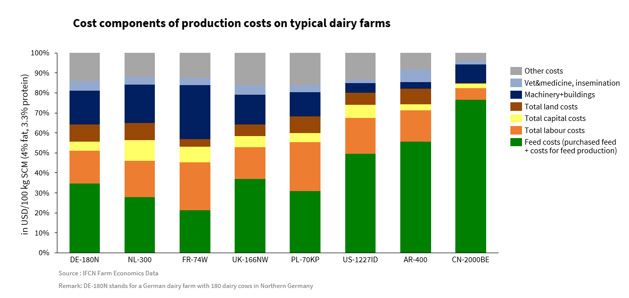
For dairy farming, this link is particularly important. Feed represents the largest cost component on most dairy farms, accounting for between 30% and nearly 90% of total production costs, depending on the production system. In intensive systems, feed typically represents 30–50% of total costs, making it the most important driver of farm profitability.
Fuel and energy themselves account for a smaller share, usually around 5% of total farm costs. Yet they reinforce the same direction of pressure: rising costs and tightening margins.
Feed markets transmit the shock
Energy price volatility reaches dairy farms primarily through feed markets.
Higher oil prices increase the cost of producing and transporting feed crops such as maize, wheat and soybeans. Fertilizer production becomes more expensive, field operations require more costly fuel, and global shipping costs often rise as well.
These factors collectively push feed prices higher, usually with a delay of several months.
At the farm level, however, feeding costs tend to adjust more gradually than market prices. Many farmers maintain feed stocks or purchase feed months in advance. Others respond by adjusting feed rations, substituting ingredients or optimizing diets to reduce costs while maintaining milk output.
As a result, the initial response to rising feed prices is often an improvement in efficiency rather than an immediate reduction in production.
Fertilizers: the hidden link
Between energy markets and feed production lies another critical layer: fertilizers.
Nitrogen fertilizers such as ammonia and urea are produced through highly energy-intensive processes that rely heavily on natural gas. This makes fertilizer production extremely sensitive to energy price volatility.
The global fertilizer market is also geographically concentrated. Major producers include companies such as CF Industries, Nutrien and Yara, while a significant share of production capacity is located in regions with access to low-cost natural gas, including the United States, Russia and the Middle East.
Large producers in the Gulf region – including facilities in Qatar, Saudi Arabia and the United Arab Emirates – supply significant volumes of ammonia and urea to global agricultural markets.
Europe has already experienced the vulnerability of this system. During the energy crisis of 2022, several European nitrogen fertilizer plants reduced output or temporarily halted production because high natural gas prices made operations uneconomic. As a result, Europe became more dependent on imported fertilizers.
Any renewed volatility in energy markets therefore has direct implications for fertilizer prices, crop production costs and ultimately feed markets.
The strategic risk: global shipping routes
The geopolitical context adds another layer of uncertainty.
One of the most strategically important transport routes for global energy markets is the Strait of Hormuz, located between Iran and Oman. Roughly 20% of global oil trade passes through this narrow maritime corridor every day.
Any disruption to shipping in this region would immediately affect global energy markets and could increase transportation costs across multiple commodity supply chains.
Even temporary disruptions can have significant consequences. In 2021, the grounding of the container vessel Ever Given blocked the Suez Canal for six days, temporarily halting around 12% of global trade passing through the route. The incident caused widespread supply chain disruptions and sharply increased freight rates.
While the Strait of Hormuz remains open, geopolitical tensions in the region highlight how vulnerable global supply chains can be when critical maritime chokepoints are affected.
UNLOCKING THE POWER OF DAIRY INTELLIGENCE
Built to empower industry peers with trusted insights to shape smarter, faster and more impactful decisions for the future of dairy
Demand signals are beginning to return
Demand signals appear to be one factor behind the improvement in market sentiment. Import demand in several key regions weakened during the period of high inflation and slower economic growth in recent years. As macroeconomic conditions stabilize, some of these markets are showing early signs of recovery.
China remains a central factor in this context. Market reports indicate relatively low inventories of certain dairy products following a period in which imports slowed and domestic milk production expanded. At the same time, growth in Chinese milk production has recently moderated. Together these developments suggest that import demand may gradually strengthen again.
More broadly, global economic conditions have begun to stabilize after a period characterized by high inflation, rising interest rates and slower economic growth. While recovery remains uneven across regions, the improvement in macroeconomic conditions has contributed to a somewhat more positive outlook for food demand.
Why 2026 may be different from 2022
The economic consequences for dairy markets will depend not only on input costs but also on the broader supply situation.
In 2022, rising costs were eventually offset by sharply increasing milk prices. Higher dairy commodity prices supported farm income despite significant cost inflation.
The current market environment looks different.
Global milk production in 2025 increased by more than 2.3%, well above the long-term growth trend. Milk supply expanded across most major exporting regions, leaving the market relatively well supplied.
Milk prices at the beginning of 2026 are close to 40 USD per 100 kg of solid-corrected milk in Germany and several other major producing countries. These levels already reflect strong supply growth in the second half of 2025.
This creates a different economic situation than in 2022. If input costs rise again while milk prices remain under pressure, dairy farmers may face a renewed squeeze on margins.
Producers who have invested in productivity improvements and cost optimization are likely to remain resilient. Others may face more difficult decisions, particularly farms that were already considering structural exit due to succession challenges.
The impact on milk supply is therefore likely to be gradual rather than dramatic. Lower-productivity cows typically leave the herd first, while the remaining animals maintain relatively high milk output.
A shock that may only be beginning
Energy shocks rarely remain confined to energy markets. They ripple through fertilizer production, agricultural inputs and feed markets before eventually reaching farm economics.
The early signals are already visible. Oil prices have moved sharply higher, and feed markets have begun to react.
For now, the global dairy sector still benefits from relatively strong milk supply. But if energy volatility persists, the cost side of the equation could tighten quickly.
In commodity markets, the first reaction is rarely the full story.
Oil tends to move first.
Agriculture usually follows.
